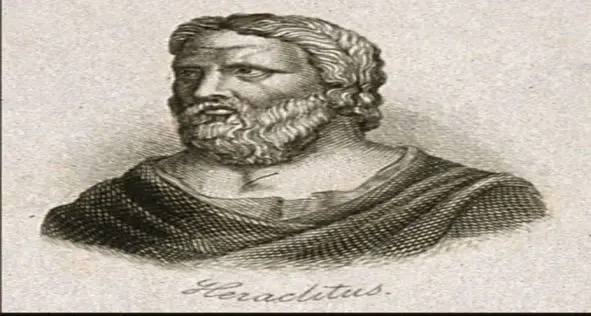


His surviving words arrive not as systematic arguments or polished doctrines, but as flashes of insight—brief, burning fragments that seem to illuminate the human condition for a moment before vanishing again into darkness. His sayings do not merely communicate ideas; they disturb the mind into wakefulness.
Javid M Rumi
Across the history of human thought, very few philosophers have spoken with the strange intensity of Heraclitus. His surviving words arrive not as systematic arguments or polished doctrines, but as flashes of insight—brief, burning fragments that seem to illuminate the human condition for a moment before vanishing again into darkness. Yet it is precisely this unfinished, incendiary quality that has kept his voice alive for more than two thousand years. His sayings do not merely communicate ideas; they disturb the mind into wakefulness.
Heraclitus understood existence as perpetual movement. The world, for him, was not a fixed order resting in stability, but a living process of transformation. He chose the metaphor of fire to express this reality—not ordinary physical flame, but an ever-living principle of becoming. Everything changes, converts, dissolves, and renews itself. Nothing remains entirely what it was a moment ago. Human beings, societies, desires, beliefs, and even identities are caught within this ceaseless movement.
The famous image of the river captures this insight with haunting simplicity: one cannot step into the same river twice, because both the river and the person entering it are already changing. In this single vision lies a profound truth about human existence. We long for permanence, yet life moves beneath our feet like water. Relationships evolve, convictions alter, memories fade, and the self itself becomes a succession of inward transformations. Heraclitus does not lament this condition; he reveals it as the very law of reality.
At the centre of his philosophy stands the idea of the logos—a word that cannot be translated fully into any single English equivalent. It suggests reason, order, speech, meaning, and the hidden pattern that runs through existence. The logos is common to all, Heraclitus insists, yet most people live as though trapped within private illusions. They hear without understanding. They look without truly seeing. Their lives become mechanical repetitions of inherited opinions rather than conscious participation in reality.
This criticism feels strikingly modern. Even in an age overflowing with information, genuine understanding remains rare. Public life is crowded with noise, slogans, emotional excess, and intellectual imitation. Heraclitus warns against precisely this condition: the sleep of consciousness. For him, the waking person shares a common world grounded in awareness, while the sleeping person retreats into a private realm of confusion and fantasy. Sleep, in his language, is not merely physical rest—it is spiritual inattentiveness.
The philosopher, therefore, turns inward. “Inquiring within” becomes the beginning of wisdom. Self-knowledge is not narcissism but discipline. To know oneself is to observe the restless movements of desire, fear, vanity, and illusion that govern human conduct. Heraclitus repeatedly suggests that the soul possesses depths beyond ordinary comprehension. Human beings often remain strangers to themselves because they fear silence and introspection.
His reflections on the soul are severe, almost ascetic. He associates moisture with softness, intoxication, and moral weakness, while dryness symbolises clarity, restraint, and intelligence. A “dry soul” is wise because it is not drowned by uncontrolled appetite or emotional excess. Heraclitus distrusts indulgence. He sees complacency as one of the great dangers of human life, for comfort easily becomes intellectual decay.
This harshness should not be mistaken for pessimism. Heraclitus does not despise humanity; rather, he refuses to flatter it. He believes conflict itself is necessary for growth. Harmony is born from tension, just as the bow functions through resistance and the lyre produces music through stretched strings. Opposites are not enemies to be abolished but forces whose interaction creates reality. Day and night, hunger and satisfaction, illness and health, life and death—all define one another.
Such thinking overturns simplistic moral certainty. Heraclitus observes that justice can only be understood because injustice exists. The physician gains recognition through disease. Rest becomes meaningful after labour. Human beings often recognise value only through deprivation. In this sense, struggle is not accidental to existence but constitutive of it.
Perhaps no fragment expresses this vision more provocatively than his declaration that “war is father and king of all.” He does not glorify violence in the ordinary political sense. Rather, he recognises that conflict governs the unfolding of reality itself. Everything emerges through opposition and contest. Without tension, existence would collapse into lifeless uniformity.
This insight gives Heraclitus an unexpectedly contemporary relevance. Modern psychology, literature, and philosophy continue to wrestle with the productive role of contradiction within human experience. Great art often arises from inner conflict. Moral growth frequently emerges from suffering. Even societies evolve through friction between competing visions of truth and justice. Heraclitus refuses the fantasy of effortless harmony. For him, authentic order is dynamic rather than static.
Equally remarkable is his critique of religious emptiness. Heraclitus attacks hollow rituals, drunken ceremonies, idol worship, and those who mistake external performance for spiritual insight. Purification without understanding, he argues, cannot truly cleanse anyone. The target of his criticism is not faith itself, but spiritual complacency—the tendency to hide ignorance beneath sacred language.
In this respect, his thought carries enduring force. Human beings often substitute slogans, symbols, and institutional identity for genuine ethical seriousness. Heraclitus insists that wisdom cannot be inherited mechanically through custom or authority. It demands vigilance of mind. The divine, in his fragments, is not confined to statues or ceremonies but appears as the deeper intelligence permeating reality itself.
His language about God remains elusive yet profound. The divine resembles the logos: a unifying presence within the ceaseless transformations of existence. It is closer to consciousness and order than to mythology. At the same time, Heraclitus maintains a fierce sense of human limitation. Compared to divine intelligence, human greatness itself appears ridiculous. What humans celebrate as achievement may look childish from a higher perspective.
This humility protects his philosophy from arrogance. Wisdom, for Heraclitus, is not the accumulation of information. One may possess extensive learning and remain foolish. True wisdom consists in recognising the deeper unity underlying apparent chaos. It is an activity of the mind that cannot be reduced entirely to speech. His fragments continually approach truths that language itself struggles to contain.
That is why his style matters so profoundly. Heraclitus writes in aphorisms because reality itself appears fragmented, paradoxical, and unstable. A rigid philosophical system would betray the very world he seeks to describe. His sentences arrive like sparks—brief illuminations rather than final explanations. Each fragment invites interpretation while resisting complete closure.
This literary quality explains why poets, psychologists, theologians, and philosophers continue returning to him. He speaks not only to the intellect but to human consciousness itself. Reading Heraclitus feels less like studying a doctrine and more like encountering a mind perpetually awake to contradiction and transformation.
His influence across history has been immense. Plato and Aristotle wrestled with his ideas; Marcus Aurelius absorbed aspects of his vision into Stoic reflection. Echoes of his thought appear in religious traditions, mystical writings, and even modern discussions of physics and energy. Yet Heraclitus himself remains singular—neither prophet nor systematic philosopher, but a thinker of perpetual becoming.
What finally emerges from his fragments is not despair, but attentiveness. He urges human beings to awaken from intellectual sleep, to resist empty speech, to cultivate inner clarity, and to confront reality without illusion. His philosophy offers no comforting escape from conflict or impermanence. Instead, it teaches the difficult art of living consciously within them.
In a world increasingly dominated by distraction, noise, and ideological certainty, Heraclitus speaks with renewed urgency. He reminds us that wisdom begins not in possession of absolute answers, but in the courage to confront change, contradiction, and the restless fire at the centre of existence itself.
The writer is a philosophy student
ja*************@***il.com