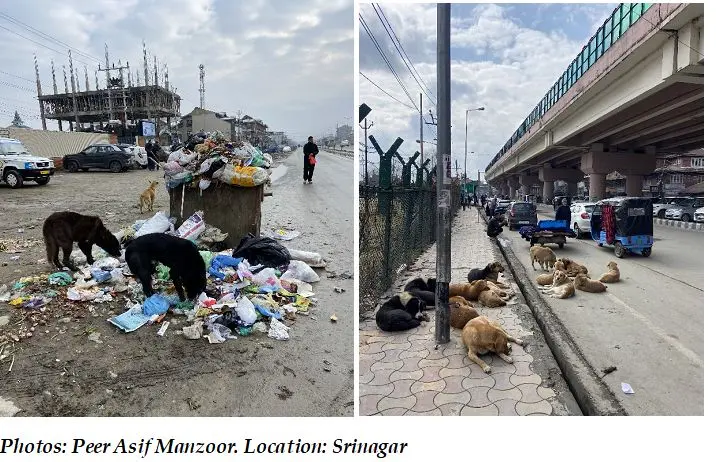


J&K has the second-highest number of stray dogs in India—23 dogs per 1,000 people. Srinagar has one stray dog for every 13 humans. The Netherlands followed CNVR (Capturing + Neutering + Vaccinating + Releasing) and became a country with no stray dogs. Bhutan achieved 100 per cent sterilisation and vaccination. Mumbai provides shelter homes for dogs. The problem needs a humane approach backed by science.
Peer Asif Manzoor
The street dog menace is a public health crisis that Kashmir has been grappling with for many years now. Ask an elderly man what street dogs mean to him, and he will shiver while narrating his encounter with being chased by a group of dogs while going to offer Fajr Salah. On one side, we have the tragic tales of victims—children, young and old—who have been bitten by street dogs during the odd hours of the day. On the other side, we have animal rights activists who champion the rights of these four-legged animals. After all, they have the right to live, the right to food, and the right to roam in commonly shared streets.
The Scale of the Crisis
According to statistics, Jammu & Kashmir has the second-highest number of stray dogs in India, with approximately 23 stray dogs per 1,000 people, following Odisha, which has 39.7 dogs per 1,000 people. The number is rapidly increasing every year. It is estimated that Srinagar city has one stray dog for every 13 humans.
Jammu and Kashmir reported over 2.13 lakh cases of dog bite incidents in the last three years (between 2022 and 2025), of which the Kashmir division reported 1,14,498 cases. Srinagar remains the hotspot for dog bites, recording 36,406 cases during the same period. Every day, 150 bites are reported in the Union Territory. With the rise in cases of dog bites, the problem has attained the status of a public health crisis.
Street dogs attain impunity under the Prevention of Cruelty to Animals (PCA) Act, 1960. No animal can be killed or inhumanely treated under this act. Animal rights activists press for the safety of these animals. For victims, the threat of rabies infection after a dog bite creates a psychiatric phobia, particularly among children. The burden of vaccination on the health department is another cause for concern.
The problem needs a humane approach backed by science and accepted, as far as possible, by all stakeholders.
A Step-Wise Model for Addressing the Crisis
Given below is a step-wise model that can be one of the possible solutions for addressing this crisis:
Sterilisation and Vaccination
The first step needed to control the street dog population is applying the CNVR model: Capturing + Neutering/Sterilising + Vaccinating + Releasing. The Netherlands, known as a country with no stray dogs, follows this model. The Soi Dog Foundation runs one of the world’s largest CNVR programmes in Thailand, drastically reducing stray populations and rabies risk over time.
Although authorities in Jammu and Kashmir started the sterilisation process a few years ago, it was limited to urban areas only. The need of the hour is large-scale sterilisation, like Bhutan, which achieved 100 per cent sterilisation and vaccination of street dogs.
Establishment of Dog Shelters and Designated Areas
Authorities must establish animal shelters where food, water, and roaming space are provided to dogs. Recently, the Supreme Court of India directed state authorities to move canines to designated shelters. These shelters must be located outside congested areas where human interference is minimal. Animal breeding must be minimised through sterilisation. Some agency must be assigned to take care of these shelter homes, backed by trained staff. Waste food that is readily available in Kashmir can be transported to these shelter homes.
Costa Rica established Territorio de Zaguates, a large-scale sanctuary, to give stray dogs a safe home. A similar model is followed in cities like Mumbai to provide shelter homes for dogs.
Management of Waste Food
It has been found that stray dogs often thrive in places where there is easy access to food. Waste food thrown in the open and in unclosed bins on our streets gives four-legged animals easy access to food, which is one of the reasons for the rising population of stray dogs. If this waste food is managed scientifically, the dog population can be controlled systematically.
The Srinagar Municipal Corporation’s (SMC) initiative of collecting garbage directly from houses through vans is a good control measure. Local people must also cooperate by not throwing garbage in the open. Non-governmental organisations (NGOs) can play a role in collecting waste food, particularly during weddings, and transporting it to dog shelters.
Establishment of a Dog Management Authority
A designated dog management authority can be established to manage street dogs. This could be a wing of the Animal Husbandry Department, a sister organisation of the SMC, or an independent authority that would work in coordination with the Municipal Committee, Health Department, and Veterinary Department. The authority would look after sterilisation, vaccinations, data on bite cases, waste management, and shelter homes. Specific roles must be defined in clear terms.
Timelines
Projects without deadlines often fail to achieve desired results. Concerned authorities must ensure that after five years, there should be almost zero cases of dog bites in Srinagar city.
A five-year plan must begin with sterilisation in the first year, establishment of shelter homes in the second year, and 100 per cent sterilisation in the third year, along with the shifting of dogs in the third year. A high-ranked officer must monitor the progress of the work.
The above-mentioned model is one of the possible solutions to the street dog menace. If concerned authorities follow this multi-level approach in a time-bound manner, they can do a great service to restore public health and give a sense of safety to the common man, while also ensuring better animal welfare.
pe*************@***il.com