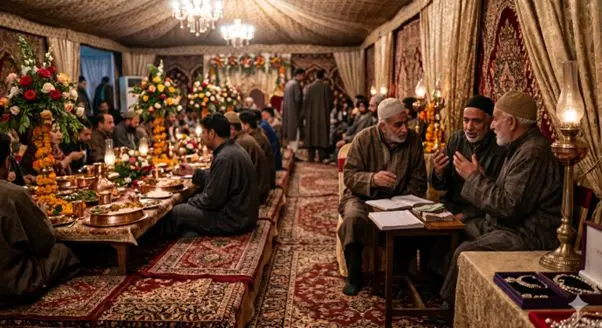


In Kashmir, families are not merely engaging in display by choice; they are responding to an informal but powerful system of expectations where deviation invites judgment and loss of honour. What was once a blessing is increasingly becoming a financial test.
Zeenat Aman, Ruqiya Jaan & Dr Rameez Ahmad
In Kashmir, weddings were once a reflection of simplicity, dignity, and shared happiness. A modest nikah, a warm gathering, and sincere blessings were enough to unite two families. As sociological understanding suggests, institutions such as marriage form the foundational structure of society, particularly in South Asia, where they are deeply embedded in religious and cultural traditions. Historically, while marriage has been recognised as a social contract, it was never confined to a narrow legal sense; rather, it embodied a deeper spiritual and emotional bond grounded in simplicity, mutual respect, and collective well-being.
Today, however, this sacred institution is gradually transforming into a barrier- especially for those who cannot afford it. What was once a blessing is increasingly becoming a financial test, where dignity is overshadowed by display and comparison. This shift reflects not merely a change in practice, but a transformation in the very meaning of marriage- from a sacred union to a performative event shaped by consumerist values.
Across towns and villages, a silent crisis is unfolding. Many young women are unable to marry- not because they lack education, values, or willingness, but because their families cannot meet the rising “standards” of weddings. Take the example of Sana (name changed), a well-educated girl from a modest background. Her father, a daily-wage worker, has spent years trying to save for her marriage. Yet, each proposal comes with unspoken expectations- grand celebrations, expensive clothing, and costly “gifts”. One by one, proposals fade away. With each passing year, hope grows quieter. Sana is not alone; she represents countless daughters who continue to wait in silence.
This situation is not merely about rising costs; it reflects a deeper sociological process. Weddings in contemporary Kashmir are increasingly shaped by status competition, where families feel compelled to demonstrate their social standing through visible consumption. As Thorstein Veblen argued, societies often engage in “conspicuous consumption”, where spending is driven not by necessity but by the desire for recognition and prestige. In such a context, even economically weaker families feel pressured to imitate the standards set by the more affluent.
The persistence of extravagant weddings, despite widespread awareness of their harmful consequences, points to a deeper social compulsion. Families are not merely engaging in display by choice; they are responding to an informal but powerful system of expectations where deviation invites judgment, loss of honour, and even exclusion from social networks. In such a setting, restraint becomes risky, while extravagance operates as a form of social insurance.
Modern Kashmiri weddings have become stages of display, where social worth is measured through visibility and expense rather than ethical values. Lavish banquet halls, designer outfits worn for a few hours, and extravagant wazwan feasts with dozens of dishes have become normalised. Ironically, significant portions of food are often wasted, yet simplicity is frequently perceived as inadequacy or even embarrassment. This reflects a broader cultural shift from community-oriented traditions to consumer-driven practices.
Dowry, though rarely demanded explicitly, continues in subtle and institutionalised forms- furniture, electronics, gold, and cash. These expectations operate through what Pierre Bourdieu conceptualised as symbolic violence, where social pressures are internalised to the extent that they appear natural and unquestionable.
Sociological understanding also emphasises that diversity is an essential feature of society and must be respected rather than erased through comparison. In the context of marriage, however, this principle is often distorted. Instead of prioritising compatibility of values, temperament, and life goals, families tend to evaluate matches through visible markers such as income, lifestyle, and display of wealth. Such comparisons not only delay marriages but also affect the quality of relationships after marriage.
At times, an additional yet often overlooked barrier lies in the lack of open communication between prospective partners and their families. Unspoken expectations regarding finances, lifestyle, and social obligations create misunderstandings even before the marriage begins. Encouraging honest dialogue about priorities, capacities, and values can reduce unnecessary pressure and help build relationships grounded in clarity and trust. When families communicate openly, marriage becomes less of a burden and more of a source of peace and stability.
When unions are built on competitive standards rather than mutual understanding, they risk turning into sites of tension- over earnings, lifestyle expectations, and reciprocal obligations during family functions, often giving rise to dissatisfaction and informal conflicts within and between families.
While it is true that both men and women today contribute economically, their roles and life experiences are not always identical. Biological and social realities, including childbirth and caregiving responsibilities, may at times shape women’s economic trajectories differently. This makes it all the more important to anchor marital decisions in compatibility and shared understanding rather than rigid economic comparison. At the same time, it is important to recognise that young men, too, face pressures- as expected breadwinners, many struggle with unemployment, financial instability, and the burden of meeting rising social expectations. However, the consequences of delayed marriage tend to be more socially visible and burdensome for women, reflecting the continued operation of patriarchy as a lived social practice. This also places a moral responsibility on men to challenge and reform such practices rather than reproduce them.
Within this context, a new and often overlooked social category is emerging- the “waiting daughter.” She is educated, capable, and willing, yet her transition into married life is delayed by structural constraints beyond her control. Her waiting is not a personal failure, but a social condition produced by norms that prioritise display over dignity.
At the same time, a stark contrast persists. On one side, extravagant sums are spent- and often wasted- on a single wedding. On the other hand, families struggle to arrange even the most basic ceremony. Such disparities reveal how cultural practices, when shaped by inequality and competition, can produce exclusion rather than cohesion.
Addressing this issue requires both individual and collective shifts. Informal interactions with married couples reveal a sense of helplessness, as many acknowledge that even when they personally prefer simplicity, social expectations compel them to conform. Yet, a smaller but significant section advocates for change, emphasising the need to take principled stands against such practices.
In this regard, there is a pressing need for “sociology champions”—young, informed sociologists capable of engaging society through awareness, dialogue, and critical reflection. Such actors can guide families towards informed decision-making, emphasising compatibility, dignity, and social responsibility. They can also play a transformative role in addressing social evils, initiating awareness programmes, and gradually reconstructing social norms on more just and rational foundations by putting sociological knowledge into practice.
At a broader level, both community initiatives and institutional support have a role to play. Encouraging moderation, strengthening awareness against dowry practices, and promoting simple marriages can gradually reduce the pressures that burden ordinary families.
Kashmir has long been known for its rich cultural and ethical traditions. Re-engaging with these values- where marriage is understood as a bond of simplicity, mutual respect, and emotional connection- can serve as a powerful counterbalance to the growing culture of materialism.
Unless society redefines honour away from public exhibition and towards ethical responsibility, weddings will continue to function as mechanisms of exclusion rather than inclusion. Until such a shift occurs, many daughters will continue to wait- not for love, but for affordability.
The writers are affiliated with the Department of Sociology, GDC Thindim, Kreeri. Dr Rameez Ahmad is a Senior Research Fellow, Department of Sociology, Aligarh Muslim University (AMU). Zeenat Aman and Ruqiya Jaan are pursuing undergraduate studies.
ra*********@***il.com