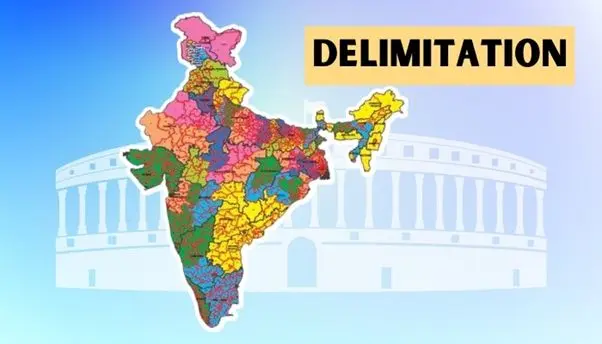


Equal state representation sounds fair—but it would deepen inequalities, weaken accountability, and introduce fresh distortions. The way forward lies in political negotiation, not structural overhaul.
Suhail Farooq Khan
India’s long-delayed census and the prospect of a fresh delimitation exercise have revived a fundamental constitutional question: how to reconcile the democratic ideal of equal representation with the practical demands of a diverse federal system. The guiding principle, “one person, one vote”, suggests that Lok Sabha seats should reflect population. Yet, in a country marked by deep regional variations, redrawing constituencies solely on this basis risks unsettling the delicate balance among states.
This tension is most apparent in the widening North–South divide. Southern states, which have made notable progress in controlling population growth and improving development outcomes, now face the prospect of losing parliamentary seats. In contrast, more populous northern states stand to gain. For many, this appears less a fair democratic adjustment and more an unintended penalty for effective governance.
In response, some have proposed redesigning the Rajya Sabha to grant equal representation to all states, thereby offsetting the population-driven tilt of the Lok Sabha. At first glance, the idea is appealing. A second chamber based on equal state representation, as seen in some countries, could in theory protect smaller or less populous states from being marginalised.
However, this argument overlooks the foundations of India’s constitutional design. The Rajya Sabha was never intended to function as a chamber of strict equality. Instead, it reflects a carefully balanced compromise, with representation broadly aligned to population while preserving a federal character. Altering this arrangement would not be a minor reform; it would reshape the very logic of representation embedded in the Constitution.
The practical difficulties are equally significant. Members of the Rajya Sabha are elected indirectly by state legislative assemblies, whose sizes vary considerably. Granting equal seats to states without standardising these assemblies would create clear distortions. In larger states, candidates would require substantially more legislative support to secure election, whereas in smaller states, a small number of legislators could determine the outcome. Rather than promoting fairness, such asymmetry would deepen existing inequalities.
Moreover, this approach would intensify known weaknesses in India’s political system. Smaller assemblies, where fewer votes decide elections, are more vulnerable to cross-voting and political bargaining. Although the anti-defection law is often cited as a safeguard, its enforcement depends heavily on the Speaker, an office frequently criticised for delay and partisanship. In practice, this weakens accountability and creates space for strategic manoeuvring, undermining the stability such reforms seek to achieve.
These concerns highlight a broader truth: delimitation in India is not merely a technical process but a deeply political one. For southern states, the issue extends beyond seat numbers to concerns about diminishing voice and influence in national decision-making. For others, however, updating representation is essential to maintaining democratic legitimacy in a changing demographic landscape. This divergence of perspectives underscores the complexity of the debate.
The larger lesson is clear. India’s representational challenges cannot be resolved through simplistic institutional redesign. Proposals such as equalising representation in the Rajya Sabha may appear elegant in theory, but they risk introducing fresh distortions in practice. The Constitution embodies a careful balance between democratic equality and federal accommodation, one that cannot be easily recalibrated without unintended consequences.
Ultimately, the way forward lies in political negotiation rather than structural overhaul. India’s federal compact has always depended as much on consensus as on constitutional design. As the country approaches a critical phase in its democratic evolution, the challenge will be to ensure that the redrawing of constituencies does not disturb the fragile equilibrium that holds the Union together.
The writer is an Assistant Editor for Rule of Law Section, CEU Review for Democracy and LLM in Comparative Constitutional Law from Central European University, Vienna
su************@***il.com