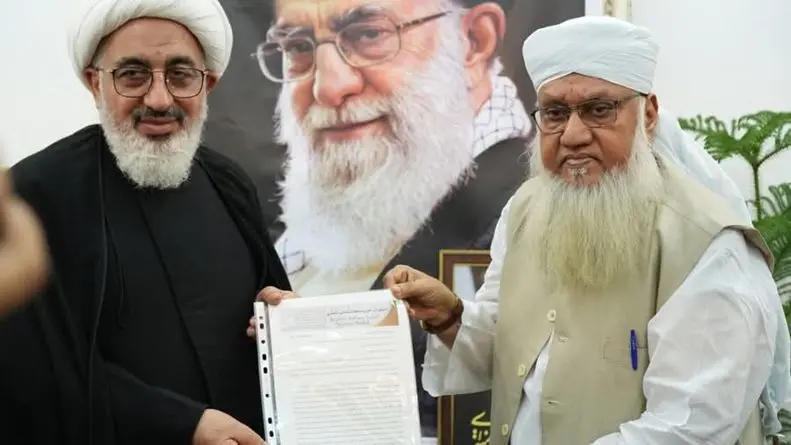


A Deobandi scholar meets Iran’s representative. The message is clear: Muslims are not destined for fragmentation. Unity is a conscious choice. This moment calls for replication—not merely in form, but in spirit.
Mohammad Kafeel Qasmi
At a time when the Muslim world is entangled in overlapping crises, geopolitical tensions, intellectual disarray, and the persistent manufacturing of sectarian divides, the recent engagement of the Sunni Islamic intellectual, Shaikh Khalil -ur-Rahman Sajjad Nomani, with the representative of Iran’s Supreme Leader in India Abdul Majid Hakeem Ilahi, stands out as a moment of rare clarity and principled leadership. It was not merely a formal interaction; rather, it carried the weight of a larger message, one that speaks directly to the urgent need for unity in an increasingly fractured environment.
In recent times, particularly in the context of escalating tensions in West Asia, the war imposed upon Iran has raised serious moral and political questions. What makes this conflict especially significant is that large-scale military strikes by the United States and Israel were launched even as diplomatic negotiations were reportedly underway. These coordinated attacks not only marked a blood-soaked escalation but also resulted in the targeted killing of Iran’s top leadership, including senior political and military figures. Such developments have reinforced the perception across many sections of the Muslim world that this was not merely a conventional conflict, but a war thrust upon Iran at a moment when dialogue had not yet been exhausted, thereby deepening sentiments of injustice, grievance, and collective vulnerability.
It is precisely in this charged atmosphere that Maulana Sajjad Nomani’s initiative becomes profoundly significant. As a Sunni scholar shaped by the intellectual traditions of the Sunni Deobandi School of thought, his engagement with the representative of Iran’s Supreme Leader, an authority embodying Shia theological and political thought, was a deliberate and thoughtful act. It effectively challenged the narrative that Muslims are inevitably divided along sectarian lines and reaffirmed the possibility of meaningful engagement across theological differences.
This gesture also gains importance when viewed against the backdrop of ongoing developments in West Asia. Reports of conflict, leadership losses, and heightened rhetoric have intensified emotional responses across the Muslim world. In India, too, these global developments resonate not only at a political level but also within public discourse, where sectarian sentiments are sometimes inflamed by selective narratives and misinformation. Social media, in particular, has become a space where polarisation is often amplified, making such unifying gestures even more necessary.
Within this context, the meeting serves as a powerful corrective. It disrupts the prevailing cycle of division and offers an alternative vision, one rooted in dialogue, mutual respect, and a shared sense of responsibility. It conveys a clear message: that the Muslim community, despite its internal diversity, is not destined for fragmentation. Rather, it possesses the intellectual and moral resources to navigate differences without descending into conflict.
India’s own historical experience reinforces this perspective. For centuries, Sunni and Shia communities in the subcontinent have coexisted within a shared civilizational framework, contributing jointly to religious scholarship, cultural life, and social cohesion. While differences have existed, they have rarely defined the entirety of the relationship. Maulana Nomani’s initiative can thus be seen as a reaffirmation of this indigenous tradition of coexistence.
Importantly, this development also carries a strong normative implication for religious leadership. At a time when sectarian rhetoric is often mobilised for narrow interests, such acts represent a form of intellectual and moral resistance. They challenge those who seek to divide the Muslim community and deny legitimacy to narratives built on discord.
However, the significance of this moment does not lie only in what has been done, but in what it calls for going forward. This is not an isolated gesture to be appreciated in abstraction; it is a model that demands to be followed. Other scholars, religious leaders, and Islamic institutions must rise to this occasion and adopt a similarly expansive and responsible approach. The challenges facing the Muslim world today cannot be addressed through insularity or silence. They require leadership that is proactive, courageous, and committed to unity.
To follow this path is not to compromise one’s doctrinal position, but to elevate it, to recognise that the higher objectives of Islamic teaching emphasise unity, wisdom, and the preservation of collective strength. Religious scholars must therefore move beyond narrow boundaries and actively work toward building bridges within the community.
In many ways, this engagement delivers a decisive blow to those forces, whether political, ideological, or digital, that thrive on division. It exposes the fragility of their narratives and reasserts a more constructive and dignified vision of Muslim unity. Yet, a single initiative, however meaningful, cannot by itself transform the broader landscape. Its true impact will depend on whether it inspires a wider movement among scholars and institutions.
The moment, therefore, calls for replication, not merely in form, but in spirit. If religious leaders across different schools of thought begin to prioritise unity over polemics and dialogue over division, a new intellectual and moral horizon may emerge, one in which differences remain, but fragmentation recedes.
In an age increasingly defined by polarisation, such gestures remind us that unity is not an abstract ideal, but a conscious and continuous choice. Shaikh Sajjad Nomani, through this engagement, has demonstrated what that choice looks like in practice. The responsibility now lies with others to follow his example and carry this message of unity forward.
The writer is an Islamic scholar, columnist and academic strategist
ka*************@***il.com