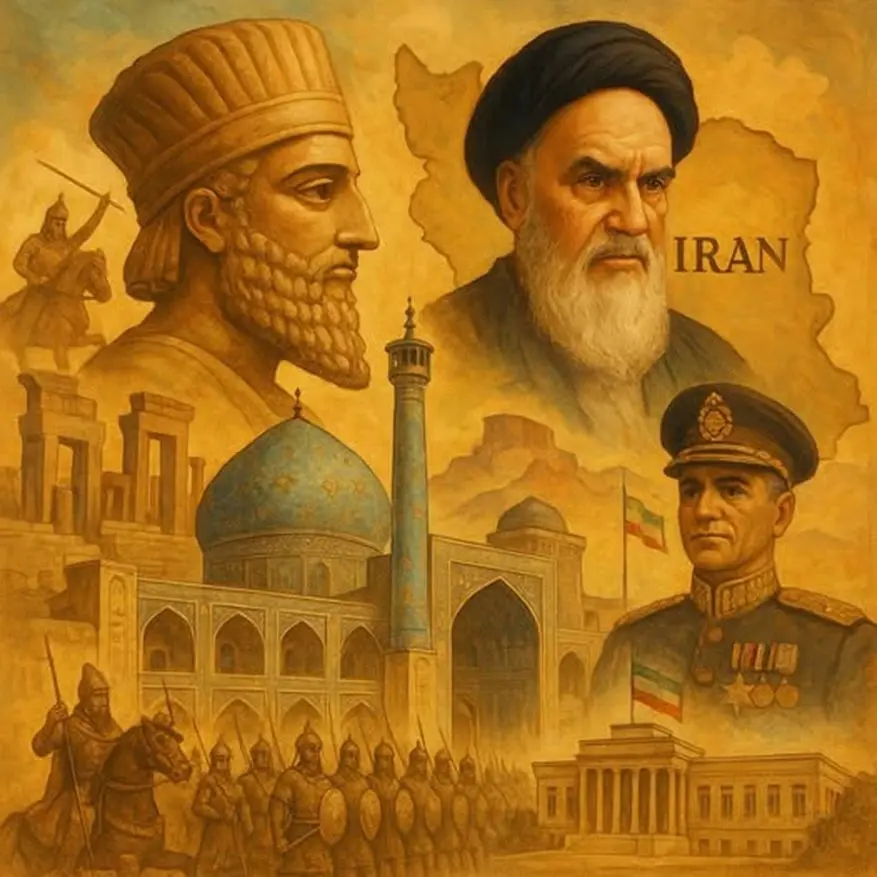


Qajar dynasty (1785–1925) institutionalised Shia clerical hierarchy. Constitutional Revolution (1905–1906) forced parliamentary governance. 1921 coup established Pahlavi rule. 1951 oil nationalisation. 1953 CIA–MI6 coup overthrew Mosaddegh. 1979 revolution followed.
Uzair Qadri
After the decline of the Safavids around 1785, Persia entered a period of political fragmentation before the Qajar dynasty established its rule, which it held from 1785 to 1925. The Qajars, while continuing the Safavid traditions in their root and branch, accelerated the concretisation of the integrated hierarchical gradation of religious clerics. The machinations and workings of the Shia jurisprudential order, which had been gestating under the Safavids, found more defined and durable expression during the rule of the Qajars.
Clerical Hierarchy
The hierarchy ascends as follows:
- Hojjetaleslam , “The Proof of Islam”, the entry-level honorific for a qualified cleric who has completed foundational studies, generally at some prominent hawza (seminary) like the ones in Qom and Najaf.
- Ayatollah, “The Sign of God” conferred upon a scholar of advanced jurisprudence with years of disciplined formation behind him.
- Ayatollah al-Uzma, “The Grand Sign of God”, the highest clerical rank, reserved for those of towering scholarly achievement.
- And above all in functional religious authority — the Marjaʿ alTaqlid, “The Source of Emulation”, the living jurist whom millions of Shias are religiously obligated to follow in matters of law and practice.
This was not merely an academic taxonomy. It was a living, breathing social institution, one that would, over time, become the seedbed of political resistance.
The Difference Between Iranian And Arab Religious Clerics
To understand why the Iranian ulema became sources of dissent rather than instruments of state power, one must juxtapose Iran with the Arabian Peninsula.
In Arabia, the religious establishment, through the Treaty of Hijaz, entered into a historic compact with the House of Saud, the powers that be. The ulema provided religious legitimacy; the rulers provided protection and resources. It was, and remains, a relationship of collusion and cooption.
Iran was different. The Shia tradition is, at its very theological root, a tradition of protest, born from the refusal to accept illegitimate authority. Also, Iran possessed a civilisational culture of debate and discussion, a society long redolent with the tradition of discourse. This was a society with an intellectual metabolism suited to argument, to questioning and to contestation.
The Shia ulema, unlike their Sunni counterparts in Arabia, remained embedded in civil society. Many of them lived and married into the trading class. This gave them organic, quotidian connections to the everyday concerns of ordinary people. They understood the price of bread, the burden of foreign concessions, the humiliation of colonial interference, etc. And they gave these grievances religious coinage, transforming economic anxiety and political resentment into the language of justice, of haqq, of standing against tyranny.
The Constitutional Revolution: 1905–1906
All of the ferment came to its first great political flowering in the Constitutional Revolution of 1905–1906. That was a landmark moment when the Ayatollahs and senior clerics, alongside workers, merchants, intellectuals, and reformers, collectively forced the Qajar Shah to accept constitutional governance. The ulema became essentially constitutive of the Iranian state, not merely commentators from the sidelines but active architects of a new political order.
The revolution produced Iran’s first constitution and parliament (Majlis), and it represented a big leap in the development of democratic traditions rooted in representativeness and decentralisation. They were anchored in Iranian and Islamic concepts of consultation, accountability, and limiting arbitrary power.
This democratic experiment, fragile and contested as it was, continued to evolve until 1921.
Reza Khan And The Pahlavi Interruption
In 1921, a Cossack Brigade general, Reza Khan, executed a coup, seized power, and dismantled the Qajar order. By 1925, he had crowned himself Reza Shah Pahlavi, founding the Pahlavi dynasty (1925-1979). He pursued aggressive modernisation and centralisation, suppressing both the clerical establishment and regional autonomy. His son, Mohammad Reza Shah Pahlavi, succeeded him. It t is in his reign that the most consequential events of modern Iranian history unfolded.
Mosaddegh And The Best Experiment Of National Alliance
By the late 1940s, Iran was sitting atop one of the world’s great oil reserves, yet the overwhelming share of its petroleum wealth was being extracted and controlled by the Anglo-Iranian Oil Company (AIOC), a British enterprise. The Iranian state received a pittance; British shareholders prospered enormously.
Into this charged atmosphere stepped Mohammad Mosaddegh, lawyer, democrat, aristocrat by birth but genuine nationalist by conviction, and arguably the finest political mind Iran produced in the twentieth century. He led the National Front (Jebheye Melli) — in what was National Alliance, a broad coalition of liberals, nationalists, religious moderates, and civil society voices united around a programme of sovereignty, constitutional governance, and control over Iranian resources.
In 1951, Mosaddegh became Prime Minister and almost immediately nationalised Iranian oil. The Majlis voted for it unanimously. Mosaddegh was celebrated across the developing world as a hero to colonised peoples everywhere who dreamed of the same.
Britain was furious. The interests of the United Kingdom were in grave danger. London first imposed a devastating economic blockade and oil embargo, then turned to Washington. The British framed Mosaddegh’s nationalisation not merely as a commercial dispute but as an opening for Soviet communist penetration of Iran, a framing calculated to alarm Cold War America.
The United States and the United Kingdom together approved what followed. In August 1953, the CIA and MI6 jointly orchestrated a coup that overthrew Mosaddegh’s democratically elected government.
Mohammad Reza Shah, who had briefly fled the country to South Africa before and during the crisis, was restored to his throne, now fully dependent on Western backing and increasingly authoritarian in his methods.
The Long Shadow
The destruction of Mosaddegh was not merely a political tragedy for Iran. It was a civilisational wound. It extinguished the most serious attempt in Iranian history to build a sovereign, democratic, constitutional state, one that married Persian political culture with modern representative institutions, without subordinating itself to either Western imperialism or clerical authoritarianism.
The decades that followed, of Pahlavi autocracy, SAVAK repression, etc., created precisely the conditions in which the radical clerical alternative found its mass constituency. The revolution of 1979 was, in no small measure, the delayed and distorted consequence of 1953.
Iran’s tragedy is that its democratic instinct, nurtured through the Qajar period, expressed in the Constitutional Revolution, embodied in Mosaddegh, was not allowed to mature. What could have been a beautiful, democratic period of Iran and the region was strangled, from outside, at its most promising moment.
The writer is a tutor
mo*************@***il.com