

BOOK REVIEW
It’s a poetic odyssey where faith, memory and Kashmir’s beauty is entwined
Manzoor Akash
Dr Rafeeq Masoodi needs no introduction. He is a multifaceted personality in Kashmir’s cultural landscape – a poet, broadcaster, administrator, and translator. He shaped generations through institutions like Radio Kashmir and Doordarshan, and brought works like Tamas & Ardh Narishwar into Kashmiri. His poetry, such as “Panun Doud Panin Dag” (My Pain, My Affliction), resonates with lyrical introspection.
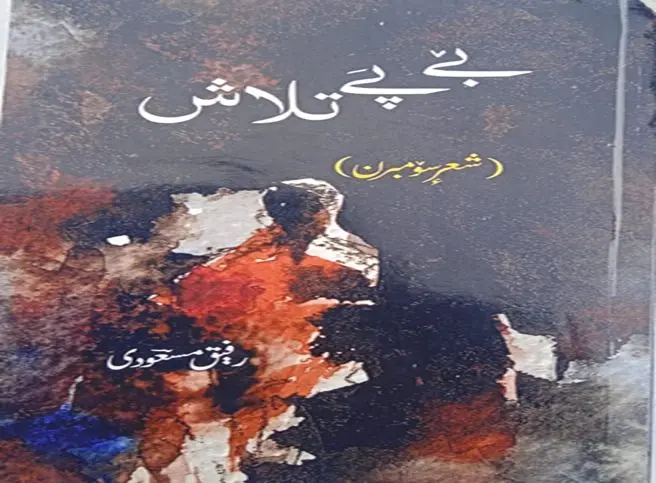
His recent publication, “Bey Pie Talash”, created waves in literary circles. Written in free verse, it’s accessible even if you are not a Kashmiri expert. The poems touch upon issues we all face–locally and globally. As if Kashmir’s voice is speaking to the world. The book begins with ‘Bar-e-Ilaehi’, praising God, seeing His signs everywhere. In the ‘Ya Rahmatal Lilaalameen’ poem, Mr Masoodi expresses devotion to Prophet Mohammad (PBUH), who showed us the path of unity and humanity. As he writes, “Kash Lagihe Pai, Asi Kus Rachihe, Sas Badin Khodayan Nish, Boche Heth Khyavin Chavin, Cxe Hechnaevith Sorui Keenh”–a beautiful reflection on life’s true values.
Bey Pie Talash is a book of 138 poems, published by Taj Printing Service, Delhi. It has a beautiful cover designed by Javaid Iqbal and Jameel Ansari. The book is dedicated to the poet’s loved ones, setting an emotional tone. Prof. Shad Ramzan, noted academician and poet, in the preface of the book, as ‘Kaethi Manz Bawan Kath’, writes about Kashmiri poetry’s history, placing Rafeeq Masoodi’s work in that tradition. Prof. Nazir Azad praises the collection’s depth and Masoodi’s ability to connect faith, memory, and society.
Rafeeq Masoodi starts this offering with a hymn to God, describing nature’s beauty. He writes about the Quran’s sanctity and the Prophet Muhammad’s (PBUH) mercy and guidance. He’s a devoted follower of Ahl al-Bayt, writing about Karbala’s tragedy and Imam Hussain’s (RA) martyrdom with sorrow and reverence. He also seeks blessings from Kashmir’s patron saint, Sheikh Hamza Makhdoom (RA), for guidance and light.
Today’s world is all about ‘me’. We are disconnected, busy with our own lives, and have no time for others. Poet Rafeeq Masoodi is disturbed by this. In ‘Kaehin Chun Aalav Bozan’, he says, “Khamoshi Hund Zyuth Samandr, Kath Ne Kunee Kin, Shuris Me Mouj Chetas, Maaji Ne Gobrui Yaad, Yi Ma Qayamat Aamich.” (Silence is like a sea… we are lost, no one’s there.) He’s highlighting how we are drifting apart day by day.
Love is universal, and Mr Masoodi had his share of love poems too. In the poem ‘Intzar’, he searches for someone who doesn’t value his emotions. As he writes, “Be Chusai Az Ti Pyaraan, Tathe Dabi Peth, Tath Khah Vati Chus, Mudai Gendith Rozaan, Magr Che Chukh Ne Vapas Yevan…” (I have given my all, but you are not coming back…)
We all know we are mortal, but we ignore it. Masoodi wants us to face it. In the poem ‘Zavaal’, he compares us to the setting sun: “The sun sets, and we are unaware… we too will leave this world.
Progress is great, but not at the cost of our mother tongue, Kashmiri. In the ‘Taraki’ poem, Dr Masoodi critiques the ironies of modernity & laments: “Myaen Zuer Ti Chi Fir Fir Urdu Angrezi Bolan, Myanin Shurin Haendh Shur Ti Chu Computrichi Saare Game Gindni Tagan, Myaenis Garas Manz Che Kaeshir Zev Vuni Budaemech, Myaen Paeth.” We teach our kids English and Urdu, forgetting Kashmiri… our own language is dying. But progress has a flip side. We need food and water to survive. In another poem, ‘Nallah-e-Hamal’, Mr Masoodi writes about the polluted stream of Nallah Hamal: “Tami Chue Vuni Rukh Badlomut, Vuni Su Chue Saen Chiz, Khahan Sanin Manz Chikhravan, Vatan Sanin Manz Chikhravan, Sonui Munvaad Palthene…” The stream has changed; it’s all dirty… we have destroyed our water, and it’s destroying us in turn.
Envy is eating us alive. We are God’s valued creation named Ashraf-ul-Makhlokat, but we have forgotten His blessings, about which the poet says in the poem ‘Azrvun’, as “Azrvun Chu Tumov Dadyo Manz Akh Bod Doad, Heivanan Che Whayad Khabar, Zi Ye Chi Mohlik Bimaer Tavai Chi Tim Ami Bimari Nish, Lob Rozaan…” (Jealousy’s a deadly disease… it’s turning us into enemies.)
Times have changed, and so have we. We used to celebrate festivals together, care for loved ones, and pray for them even after they passed. But now, life’s too busy. We barely remember them, let alone visit their graves. Poet Rafeeq Masoodi captures this in ‘Navi Zamanich Majboori’: “Cities rush, Eid is a hassle… we forget our elders, and pray for them only when needed. He writes, “Vuni Chh Tavai Tasinz Merdyadam Mouj, Tas Nish, Yevan Shahar, Tas Sa’et Eid Manavni, Su Chu Vuni Pannis Bab Saebas Shahr Paithei Faateh Soza’an…!”
In poems like ‘Myoun Sarmayh’ (My Wealth), Masoodi shares his true wealth: his experiences, struggles, and emotions. For him, poetry is a way to preserve life’s moments and feelings. Kashmiri writers Farooq Nazki, Shehnaz Rashid, and Ayoub Sabir praise Masoodi’s skill, saying he is a master at crafting emotions into verse. His poems have quiet dignity, emotional depth, and vivid imagery. Moreover, Masoodi’s language flows smoothly between the spiritual and everyday, personal and universal. His poetry isn’t just written–it’s lived. Each line pulses with experience, a heart that has seen beauty and hardship.
Rafeeq Masoodi’s poems are like mirrors, reflecting our own emotions and the world’s. He uses beautiful imagery, like “Lav’ qetre’ chu mokhte hue sobhaei gah travaan” (a drop of dew on a flower), showing his poetic skill. The poems cover many topics, giving us a wider view of life’s problems. He takes us to the stars, making us listen to the universe’s whispers.
Some poems touch on similar themes, like isolation and disconnection–”Kanh Chun Aalav Bozan, Ye Ma Qayamat Aamich Chopi Hinz” (no one’s there, it’s like the end of the world). Despite some repetition, “Bey Pie Talash”, Dr Masoodi’s latest offering, is a must-read, offering a fresh look at modern life and nostalgia. Masoodi’s poetry humanises, heals, and holds a mirror to society. It’s a reminder to slow down, feel, and remember. Come, let’s celebrate the power of words and dive into “Bey PieTalash”–a place where poetry still breathes.
ma*********@******co.in