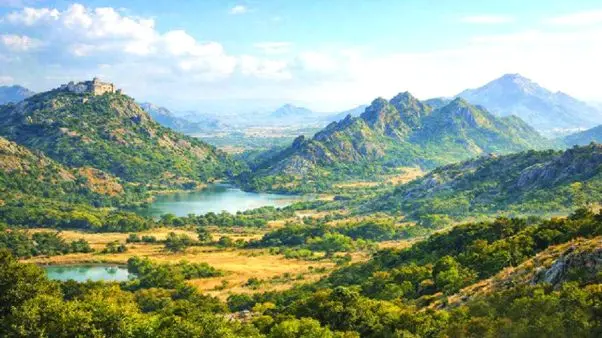


The Aravallis are the breath of life for every Indian. Older than the Himalayas, this range blocks deserts, recharges water, and hosts prehistoric sites. Now, legal ambiguity and mining threaten to fragment it beyond recovery. If we lose the Aravallis, we lose groundwater, wildlife, clean air, and climate balance.
Masroora Jan
The Aravallis are a hill system in northern India, running northeasterly for more than 650 km through Gujarat, Rajasthan, Haryana, and Delhi. This series of peaks and ridges, varying in breadth from 10 to 100 km, generally stands between 300 and 900 meters in elevation. The system is divided into two main sections: the taller Sambhar–Sirohi ranges, which include Guru Peak on Mount Abu (the highest point in the Aravallis), and the Sambhar–Khetri ranges, consisting of three discontinuous ridges. As the oldest mountain range in India—estimated to be over two billion years old—the Aravallis are rich in natural resources. They act as a critical barrier, checking the eastward expansion of the Thar Desert into Haryana, Rajasthan, and Uttar Pradesh. The range influences the movement of monsoon winds westward and blocks cold westerly winds from Central Asia in winter. It gives rise to several rivers, plays a vital role in groundwater recharge, and hosts several wildlife conservation areas across its expanse.
Discovery of India, penned by Jawaharlal Nehru, provides a balanced, meticulous, and sustainable framework for engaging with modern development. The book explores India’s vast history, culture, and geography, viewing the land—including ancient formations like the Aravallis—as integral to the nation’s identity. A contemporary reading highlights the Aravallis’ crucial role as an ecological shield against desertification and a source of water recharge—a perspective that resonates with Nehru’s broader vision of a unified and resourceful India. Although predating modern ecological discourse, Nehru’s vision of a strong, self-reliant India aligns with today’s recognition of the Aravallis’ importance.
The book clearly delineates the role of democracy and social justice, advocating for a system that promotes inclusivity, equality, and the well-being of citizens. Nehru’s exploration extends beyond culture and history to encompass India’s rich biodiversity and natural resources, which have sustained its civilisation for centuries. Agriculture, forests, and rivers are not merely economic assets but integral to cultural identity and spiritual life.
How Nehru’s Scientific Approach Guides Us
Nehru’s work is deeply philosophical, illustrating a symbiotic relationship between humans and nature where both thrive in harmony. His insights inspire a sense of environmental stewardship, promoting practices that prioritise ecological balance. In a rapidly globalising world where local identities risk being overshadowed, revisiting Nehru’s thoughts offers valuable perspectives on the significance of our cultural and environmental heritage. The book lays the groundwork for appreciating India’s diverse components—including its geology and ecosystems—as fundamental to its identity and future, a vision reinforced by later scientific understanding of ranges like the Aravallis.
Several authors have written extensively on the Aravalli range, particularly on its environmental challenges, geology, and future. Prominent among them are Laxmi Kant Sharma and Alok Sharma, who co-authored the 2025 book The Aravalli Ranges: Past, Present, and Future Prospects: India’s Natural Green Wall. Their work highlights the range’s degradation due to mining and urban expansion. A 2022 assessment documented that nearly 8% of the Aravalli hills were lost between 1975 and 2019. Geologist C. P. Rajendran, in his commentaries, has focused on the ecological and geological significance of the Aravallis, warning of the dangers posed by new governmental definitions and policies regarding the range.
The Aravallis: A Neglected Geological Marvel
Having spent nearly a decade in Delhi, mostly at Jawaharlal Nehru University—a campus built on the ancient Aravalli range, specifically its southern ridge—I have come to appreciate its profound significance. Landmarks like Parthasarathy Rock, the highest natural point in Delhi, make JNU a vital extension of the Aravallis in the capital. To understand the Aravallis deeply, one cannot overlook the historian Upinder Singh’s book Discovering the Ancient in Modern India (2010). Singh notes how a prehistoric Stone Age tool—an Acheulean hand axe—was found at a bus stop inside the forested JNU campus in 1983. As Singh observes, “People in Delhi rarely realise where they are living or driving. Delhi is not a flat landscape; in its undulating underbelly are rocks as old as life on earth—3.2 billion years old.”
There are over 40 sites in South Delhi and adjoining Haryana where ancient stone tools have been discovered, spanning from the Lower Palaeolithic to the Mesolithic periods. This area is presumed to have hosted numerous Stone Age tool-making factories. These ancient rocks are part of the Aravalli range, or “the Ridge,” as it has been known in Delhi since British rule. A large section of Delhi, including JNU, sits on this ancient formation.
Spanning over 800 km from Gujarat to Delhi, the Aravallis are older than the Himalayas in geological time. Yet, bafflingly, this mountain range and its tropical dry deciduous forests have never gained recognition as a biogeographic hotspot or an ecological heritage monument. The range has shaped much of northern India—blocking the spread of desert sand into the Indo-Gangetic plains, directing river flows, recharging groundwater aquifers, and acting as the “green lungs” for polluted cities like Delhi and its surroundings.
The Aravallis remain the last “commons,” a refuge for wildlife and hundreds of species of trees, shrubs, and herbs. Its vegetation has evolved and adapted over millions of years. The British classified the Aravallis as gair mumkin pahar (hills unfit for cultivation), yet they provided valuable metamorphic rocks—quartzite and sandstone—and were rich in minerals like zinc, gold, silver, copper, lead, limestone, and marble. The mountains have paid a heavy price for this in the form of mining. Once a contiguous range, today it survives as fragmented rocky outcrops divided into five zones. In these pockets of wilderness, jackals, nilgai, and hares still roam free. Growing anthropogenic pressure—including excessive mining and waste dumping—has altered the range beyond recognition. The hills of yore survive only in the names of localities: Raisina Hill, Manju-ka-Tila, and Paharganj.
How the Supreme Court Saved—and Endangered—the Aravallis
Legal expert Upendra Baxi once noted that the Supreme Court has provided a “chemotherapy to the carcinogenic body politics of the state,” becoming, after thirty-two years of the Republic, “the Supreme Court for Indians.” Yet, regarding the Aravallis, the Court’s role has been marked by paradox. Based on 2025 developments, the Supreme Court’s recent involvement in the Aravalli case has been controversial: an initial judgment “failed” to protect the ecology, leading to a rare stay of its own order. The very institution that once insisted on expert-driven governance now appears willing to substitute scientific analysis with judicial intuition.
Pratap Bhanu Mehta, a prominent political scientist, sees the Supreme Court as slipping into “judicial barbarism”—marked by arbitrariness, a “promiscuous” overreach of power, and a shift from constitutionalism to mere “democratic positioning.” This is especially evident in its dealings with free speech, executive power, and gubernatorial authority, where it often fails to check authoritarian trends despite occasional positive rulings. He argues the Court acts whimsically, creating ambiguity rather than a clear rule of law, and misses opportunities to uphold foundational democratic principles. Nothing is different in the case of the Aravallis.
The Supreme Court has proven itself a paradoxical institution. It adopted a scientific definition (landforms ≥ 100 meters in elevation) to define hills and ranges, banned new mining leases, ordered a management plan for sustainable mining, and directed ecological restoration. Yet, under the new rules, only hills above 100 meters qualify as “Aravalli,” dramatically shrinking the protected area. Through its own ruling, the Court introduced complexity by calling for a balance with strategic mineral mining, leading to further reviews and ongoing debates over protection levels. More than 90% of the Aravallis—the national capital’s only forest range—has been opened to potential mining and construction after the Supreme Court’s November 20 order accepted the Union Ministry’s new definition of the hills. While the Court aimed to ensure clear law enforcement, concerns remain that many ecologically vital low-lying areas may lose protection. On December 2, the Supreme Court kept in abeyance its November 20 judgment, temporarily suspending the 100-meter elevation criterion and related restrictions.
Lessons for Contemporary India
As we navigate the complexities of modernisation, the lessons from the Discovery of India remain invaluable. In a world where globalisation often threatens local identities, Nehru’s emphasis on cultural and environmental pride reminds us of the importance of heritage in shaping a resilient national character. The Discovery of India serves as a timeless reminder that our heritage is not static but a living, breathing entity that evolves with us.
“If we lose the Aravallis, we lose groundwater, wildlife, clean air, and climate balance.”
“This ancient range isn’t just rock—it’s a lifeline for water, climate, and wildlife for millions.”
“It isn’t just a hill range—it’s North India’s natural shield.”
“The Aravallis serve as an important ecological barrier, preventing the desertification of the Indo-Gangetic plains.”
Spanning nearly 700 km, the Aravalli range acts as a natural barrier, blocking sand and dust from the Thar Desert. The Save Aravalli Movement calls for a scientific, layered definition that protects both ecology and people while respecting the law, through policy reform by the Ministry of Environment.
There is one mountain range and two possible futures. The choice is ours.
SAVE THE ARAVALLIS, SAVE THE FUTURE.
The writer is from Jawaharlal Nehru University
ja*********@***il.com