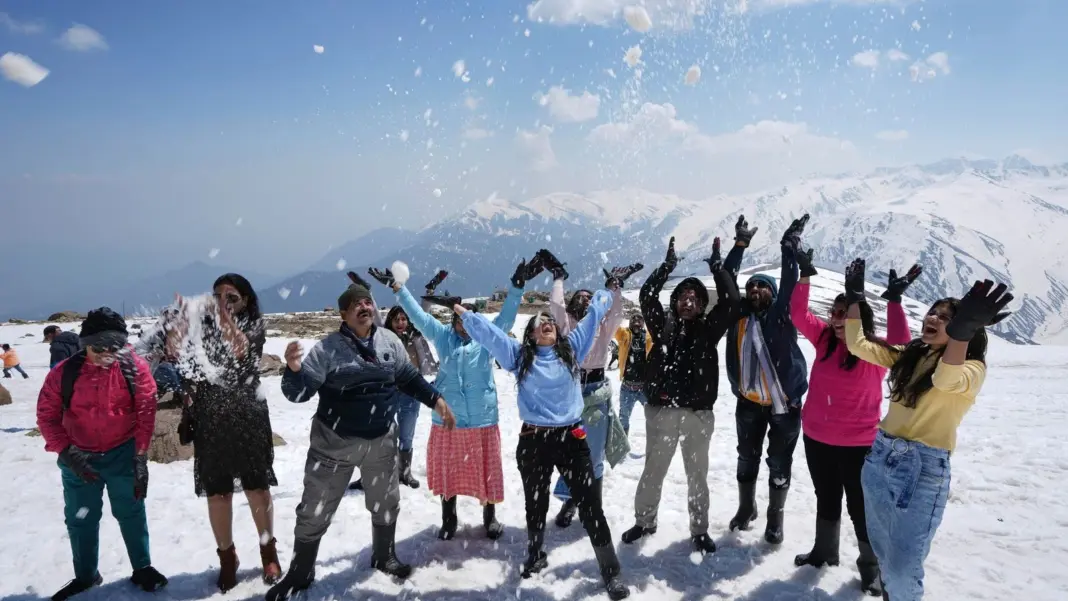


The rise of event-based travel around New Year’s marks a fundamental shift from climate-dependent tourism, creating a high-value ‘festive peak’ within the winter calendar
Sumaya Jan
Tourism has long been one of the most important economic pillars of Kashmir, shaping livelihoods, regional identity, and external perceptions of the Valley. In recent years, the sector has expanded to historic levels. Jammu and Kashmir recorded around 2.36 crore tourist visits in 2024, the highest figure since official records began, while 2025 still witnessed more than 1.5 crore visitors despite episodic disruptions. These numbers underline both the scale and resilience of the tourism economy.
Tourism contributes an estimated 7–8 per cent to Jammu and Kashmir’s Gross State Domestic Product, while indirectly sustaining a far larger share of employment across hospitality, transport, handicrafts, retail, and informal services. Yet the most significant transformation in recent years is not merely quantitative growth, but a fundamental change in tourism demand patterns. Kashmir is no longer defined exclusively as a summer destination. Instead, it is increasingly emerging as a year-round tourism economy, with winter travel, particularly around Christmas and New Year celebrations, playing a decisive role.
Changing tourism trends: From seasonal dependence to dual-season demand
Historically, tourism in Kashmir followed a sharply seasonal structure. Visitor inflows peaked between April and September, driven by gardens, lakes, and mild temperatures, while winter months were marked by low demand, underemployment, and idle capacity. Snowfall, limited connectivity, and infrastructure constraints discouraged mass tourism during December and January.
This pattern has undergone substantial changes over the past few years. Summer tourism remains strong, but winter demand has expanded rapidly, transforming December and January into high-value travel months. Importantly, winter tourism growth has not been uniform across the season. Instead, demand is highly concentrated around Christmas and New Year, creating a distinct festive peak within the winter calendar.
This shift indicates a transition from climate-based tourism to event-based tourism, where travel decisions are centred on specific calendar moments rather than relying solely on seasons. New Year celebrations have become a powerful temporal driver of tourism demand in Kashmir.
The New Year effect: Kashmir as a celebration destination
New Year tourism has evolved into a clearly identifiable segment within Kashmir’s tourism market. Over the last few seasons, hotel occupancy rates in Srinagar and Gulmarg during the final week of December and the first days of January have frequently reached 85–100 per cent. Tourism officials estimate that 20,000–30,000 tourists per day enter the Valley during the New Year week, a scale that was virtually absent in winter a decade ago.
What distinguishes this trend is intent. Tourists are not visiting Kashmir incidentally during winter; they are choosing it specifically to celebrate the New Year. Snowfall, alpine scenery, and destination-based festivities have replaced conventional urban celebrations. For many domestic travellers, celebrating the New Year in Kashmir offers novelty, symbolism, and a sense of exclusivity.
New Year tourism functions as a high-intensity demand shock: short in duration but economically powerful. In a few days, it concentrates spending, employment, and visibility at levels comparable to peak summer weeks.
Key destinations driving New Year tourism
The geography of New Year tourism is relatively concentrated, with a few destinations emerging as focal points:
- Gulmarg is the undisputed epicentre. Skiing, gondola rides, snow activities, and resort-style accommodation have positioned it as India’s leading winter celebration destination. Demand during the New Year often exceeds supply, leading to bookings and price surges.
- Srinagar, especially Dal Lake and the Boulevard Road, offers a contrasting model. Houseboat stays, winter shikara rides, cultural cuisine, and city ambience attract families and travellers seeking quieter celebrations.
- Pahalgam and Sonamarg function as supplementary destinations, with tourist flows dependent on road accessibility and weather conditions.
While Gulmarg anchors the New Year tourism narrative, over-dependence on a single destination risks congestion and environmental stress. Srinagar’s role as a scalable, experience-based celebration hub is crucial for dispersing demand.
Economic contribution of New Year tourism
The economic significance of New Year tourism is substantial despite its short duration. Winter was traditionally associated with unemployment and income uncertainty. Today, the New Year period generates high per-visitor expenditure, benefiting hotels, taxis, guides, shikara operators, restaurants, and informal vendors.
For many tourism-dependent households, earnings during the New Year week offset lean winter months, improving income stability. At a structural level, New Year tourism enhances:
- Capacity utilisation of hotels and transport infrastructure
- Employment continuity in the service sector
- Revenue smoothing across seasons
From an economic perspective, New Year tourism acts as a seasonal stabiliser, reducing Kashmir’s historical dependence on a narrow summer window and strengthening tourism’s role as a reliable economic pillar.
Governance challenges and what the government should do
The rapid rise of New Year tourism demands a shift from promotional policy to strategic destination management.
- Recognise the New Year as a formal peak season
December–January should be officially treated as a peak tourism period with destination-wise capacity limits and pricing oversight.
- Strengthen winter infrastructure and last-mile mobility
Snow clearance, parking systems, regulated transport, and emergency services must keep pace with demand.
- Diversify winter celebration spaces
Curated winter festivals, cultural evenings, night markets, and food events, especially in Srinagar, can reduce pressure on Gulmarg.
- Ensure environmental sustainability
Carrying-capacity norms, waste management, and strict regulation in snow-sensitive areas are essential.
- Confidence-building communication
Clear travel advisories and real-time updates help maintain tourist confidence in a region where demand is highly sensitive to uncertainty.
Conclusion: New Year Tourism as Kashmir’s new identity marker
The rise of New Year tourism marks a decisive shift in Kashmir’s tourism narrative. The Valley is no longer defined solely by summer landscapes; it is increasingly recognised as India’s premier winter celebration destination. This transformation reflects changing travel preferences, improved connectivity, and the growing appeal of experience-based tourism.
With tourism contributing nearly one-tenth of the regional economy, strengthening the New Year segment offers an opportunity to stabilise incomes, extend employment, and promote year-round growth. The challenge ahead lies not in attracting more visitors but in managing growth intelligently, balancing economic benefits with environmental protection and quality of experience.
If approached strategically, New Year tourism can evolve from a festive rush into a sustainable economic anchor for Kashmir’s winter economy.
The writer is a research scholar in the Department of Economics at the Central University of Jammu
su*********@***il.com