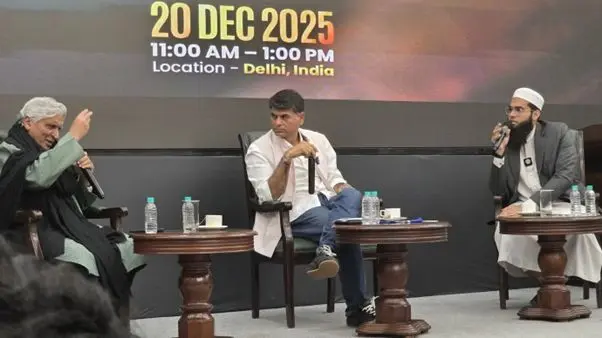


Reflecting on the Mufti Shamail Nadwi-Javed Akhtar exchange, this article calls for philosophical literacy, epistemic humility, and remembering that da‘wah aims for guidance, not theatrical domination
Dr Nazir Ahmad Zargar
The recent public discussion titled “Does God Exist?” between Mufti Shamail Nadwi, a young Islamic scholar, now known for his composure, intellectual clarity, and moral seriousness, and Mr Javed Akhtar, a prominent literary figure who openly identifies as an atheist, has generated considerable attention. After watching the debate, I immediately wrote three Facebook posts in Urdu. In retrospect, I believe those reflections should not have been written in Urdu, because they were never meant for an emotionally reactive audience. I am therefore reframing my entire argument in English, addressing it explicitly to readers who approach questions of religion, atheism, and public discourse with intellectual responsibility and philosophical sobriety. It seems necessary to offer an academic assessment that moves beyond emotional reactions and situates the discussion within a wider philosophical, theological, and da‘wah-oriented framework.
At the very outset, it can be stated fairly that Mufti Shamail Nadwi’s engagement was reassuring for ordinary believers, particularly young Muslims. His composure, confidence, and ethical restraint stood in contrast to the overt religious antagonism expressed by his interlocutor. As the general masses took the overall success of Mufti Shamail Sahab as a definitive philosophical refutation of atheism as an intellectual system, to me, it reflected the limited philosophical rigour of the atheistic position presented in this particular discussion.
Notwithstanding, I think, a major conceptual flaw in the debate lay in its framing. The title Does God Exist? implicitly places the believer on the defensive, as if non-existence were the default position. Classical metaphysics rejects this assumption. The existence of a contingent, ordered, intelligible universe already demands explanation. Denial of a transcendent ground of being is not neutrality but a substantive metaphysical claim. The burden of justification lies equally, if not more heavily, on atheism.
Although atheism has always been on flimsy grounds, the question of God’s existence is not a narrow logical puzzle. It is a multidimensional inquiry involving metaphysics, epistemology, moral philosophy, psychology, and human existential experience. Treating it as a short, adversarial public contest departs from the classical norms of serious inquiry.
Historically, arguments about ultimate reality have never been settled through rapid exchanges or performative reasoning. They require sustained reflection, layered argumentation, and methodological humility.
Modern atheism is not merely disbelief. It is a structured worldview shaped by Enlightenment rationalism, scientific naturalism, post-Kantian scepticism, and a reductionist understanding of religion. Its arguments operate within a closed epistemic framework that privileges empirical verification and logical inference while dismissing other sources of knowledge. Expecting such a worldview to collapse in a brief public debate misunderstands the nature of philosophical commitments.
In the present debate, however, Mr Akhtar’s atheism appeared less as a coherent philosophical system and more as a moral and emotional protest against religion. His objections relied heavily on indignation, selective historical references, and rhetorical confidence rather than systematic metaphysical reasoning. There was little engagement with established theistic arguments such as contingency, necessary being, moral realism, the intelligibility of natural laws, or the emergence of consciousness. As a result, the atheistic position lacked philosophical depth and internal consistency.
At the same time, intellectual honesty requires acknowledging a crucial methodological point that often remains unaddressed in such debates. Logical and philosophical arguments for God, whether cosmological, teleological, or moral, are inherently non-final. They are probabilistic, cumulative, and secondary in nature. No syllogism produces metaphysical certainty. Doubt can always trail logical inference. This is not a weakness unique to theism. It is a limitation intrinsic to human reason itself.
Islamic intellectual tradition has always recognised this limitation. Classical scholars never treated rational proofs as absolute foundations of belief. Logic serves to remove confusion, expose contradictions, and show coherence. It does not generate faith independently. Reason points, but does not compel. This is why overreliance on logical victory in public debates is epistemologically misguided. A debate may appear logically successful, yet still fail to produce inner conviction. This is precisely where prophetic authority becomes central.
In Islamic epistemology, the ultimate grounding of belief in God does not rest on abstract logic alone but on the credibility, truthfulness, and moral authority of the Prophet Muhammad (SAW). His truthfulness, integrity, transformative impact, consistency of message, and historical reliability constitute an independent and powerful source of knowledge. Prophethood bridges the gap that reason cannot fully cross. It converts abstract possibility into lived certainty.
A well-known narrative attributed to Imam Fakhr al-Dīn al-Rāzī captures this epistemic insight with remarkable clarity. It is reported that he once confronted the Devil in a dialectical exchange and presented numerous rational arguments in favour of the existence of God. Each time a proof was offered, a counter-question followed. When yet another objection was raised, Imam Razi is said to have wept, realising that purely logical argumentation has no natural stopping point. Reason can always be met with further doubt.
In the same narrative, Imam Razi later sees the great Sufi master Najm al-Din Kubra in a dream. He is advised that Satan is not silenced by dialectical reasoning alone. The proper response is not an endless chain of arguments but a shift in epistemic ground. One must say, I believe in God on the authority of the Messenger of God (Peace Be Upon Him). This, it is said, brought contentment and intellectual closure to Imam Razi.
The significance of this account does not lie in its historical details, but in the philosophical lesson it conveys. Logical reasoning is indispensable for clarifying concepts, removing confusion, and exposing fallacies. Yet logic by its very nature remains open-ended. It produces probability rather than final certainty. For every argument, a counterargument can be imagined. If belief rests solely on rational demonstration, it remains perpetually vulnerable to doubt.
Islamic epistemology, therefore, never assigned reason the role of ultimate arbiter in matters of faith. Reason functions as a guide, not as a terminus. It prepares the mind, but it does not ground conviction. That grounding comes through trustworthy authority, specifically the authority of prophethood. Revelation provides the closure that reason cannot supply.
This insight directly explains why purely philosophical debates with atheism often prove inconclusive. Atheism does not merely reject God. It rejects authoritative knowledge beyond empirical verification. In such a framework, no amount of logical reasoning can compel assent. The debate becomes infinite, not because the arguments for God are weak, but because the epistemic criteria themselves are restricted.
The lesson of Imam Razi’s reflection is therefore not anti-intellectual. It is profoundly intellectual. It recognises the limits of reason while affirming its necessity.
When applied to contemporary God debates, this framework explains why public logical victories often fail to produce genuine conviction, and why emotional reactions after such debates are misplaced. Faith is not secured by defeating an opponent in argument. It is secured by anchoring belief in a reliable source of truth.
Atheistic discourse often ignores this dimension entirely. It assumes that belief in God is derived solely from speculative reasoning. This assumption is false. For believers, God is known not only through inference but through revelation mediated by a prophet whose life itself functions as evidence. The question of God’s existence cannot be meaningfully separated from the question of prophetic truth. Any debate that isolates metaphysics from prophethood remains incomplete.
Beyond philosophy, the broader social consequences of such debates require serious attention. Public debates often give atheistic ideas visibility and legitimacy disproportionate to their intellectual strength. Lay audiences tend to judge arguments by confidence and fluency rather than coherence. For young minds with limited philosophical training, questions arise instantly while answers require time and study. When questions accumulate faster than understanding, psychological anxiety and spiritual instability follow.
Islamic tradition rarely addressed disbelief through spectacle. It relied on gradual education, disciplined scholarship, and structured reasoning. The science of kalām emerged precisely to protect belief from confusion, not to entertain crowds. Its natural setting has generally been the classroom, the study circle, and the written text.
This does not render the recent debate unnecessary. Given the repeated public mockery of religious belief by Mr Akhtar, a dignified response was required to protect vulnerable believers. The engagement served a pastoral function. It reassured those whose faith is sincere but intellectually underdeveloped. Islam itself was never under threat. However, individual believers were. Describing the encounter in terms of victory and defeat, therefore, misrepresents the purpose of da‘wah. The Qur’ānic method emphasises wisdom, ethical counsel, and the most gracious form of argumentation. The objective is guidance, not domination.
Therefore, emotional triumphalism displayed by some after the debate was neither intellectually serious nor spiritually appropriate. Belief does not require theatrical defence.
One important thing which the present debate highlighted is the relevance of logic and theology within madrasah education, where logic and kalām have long been part of the curriculum, but were declared by some to be unnecessary disciplines. But the discussion reasserted that while logic enables you to discipline your thought and identify fallacies in the opponent’s claim, the discipline of kalām trains scholars to understand objections before answering them. Islamic civilisation historically confronted sceptics, materialists, and philosophers through these sciences. Declaring them obsolete reflects ignorance of both modern atheism and Islamic intellectual history.
Equally flawed is the assumption that madrasah students lack intellectual capacity. Ability is shaped by discipline, mentorship, and seriousness, not by institutional labels. History records countless scholars trained in traditional seminaries who exercised profound intellectual influence. Universities, likewise, do not guarantee depth. Generalising individual outcomes into systemic judgments reflects bias rather than scholarship.
Madāris and universities represent distinct intellectual traditions with different strengths. When scholars trained in madāris engage contemporary debates with dignity and restraint, they demonstrate that intellectual competence is not institution-bound. What is required is depth, preparation, and epistemic humility.
Therefore, the deeper lesson one can draw from this debate lies in the need for stronger philosophical literacy, clearer epistemological awareness, and greater strategic wisdom in public discourse.
Bottomline
Belief is preserved not by emotional reactions but by knowledge. Logic assists belief. It does not replace it. Prophethood completes what reason begins. That balance has always defined the Islamic intellectual tradition. This is the real lesson to be carried forward, with dignity, restraint, and responsibility.
And Allah knows the best
The writer is a senior faculty member at the Department of Religious Studies, Central University of Kashmir (CUK)
dr*************@***il.com