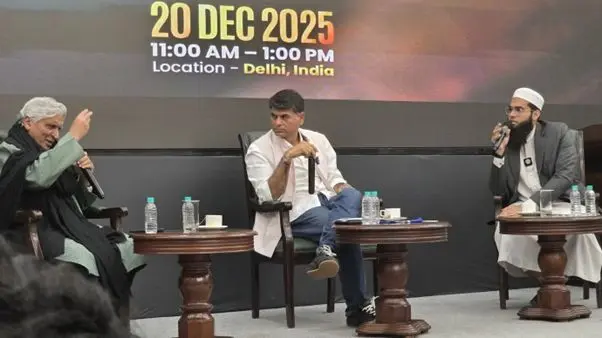


In a sensitive discussion free of abuse, each held their ground. The true takeaway? Some questions seek understanding more than answers, and humility matters more than victory.
Eyram Hamid Khan
I recently watched a contemplative yet poignant discussion between Mufti Shamail Nadwi and Javed Akhtar. The debate between Javed Akhtar and Mufti Shamail Nadwi was noteworthy not because it addressed the sensitive subject of God’s existence, but because it demonstrated that difficult concepts can be freely discussed without resorting to derogatory or abusive language, especially in Indian society. That in itself is admirable. In other countries, talking about such delicate subjects might be deadly for individuals who start the conversation.
Javed Akhtar described himself as a devout atheist, but more importantly, as someone disturbed by the suffering and injustice he sees in the world, especially in Gaza, which he repeatedly brought up. His barrage of inquiries came out as both intelligent and perceptive, but also a little emotional. He reiterated what many people secretly wonder: Why is there suffering? Why is there unfairness? What’s causing the silence? Where was God before the universe? Why does God not exist in space and time? This was a genuine way for him to express his doubts.
His logical mistake, though, was that he often believed that pain was enough to completely reject the idea of God. Pain raises important questions, but it does not automatically solve them. Occasionally, his feelings seemed to take precedence over thoughtful analysis, directing the discussion more toward moral indignation than philosophical inquiry. He became a little emotional during the cross-examination phase, but he maintained the debate’s pace.
The discussion was approached differently by Mufti Shamail Nadwi. He adhered more closely to conventional arguments and attempted to use logic and structure to support religion. He was well-prepared and, for the most part, stayed focused. His clarity of thought and discipline are his strongest assets. Unlike others, he prevented the argument from derailing.
However, his logical reasons felt somewhat disconnected from actual human experiences, a drawback. Experiencing hardship differs from talking about it. His responses lacked an emotional connection, even though they were correct in form. Logic alone can seem cold and insufficient to someone who is already in pain or doubtful.
Furthermore, examining human limitations rather than human design is an alternative approach to the subject. Using the resources at their disposal, people have always attempted to make sense of the world, and each era believed it had discovered all the solutions. However, history demonstrates that what appeared to be whole at one point later proved to be simply a part of the picture. This indicates that ambiguity is a normal aspect of being human rather than a flaw in our reasoning.
When individuals discuss God, they may not necessarily be claiming to know everything; more often than not, they are just acknowledging that not everything is certain. In this sense, belief is less about attempting to control things and more about accepting them. There is a place for scepticism as well, but when it insists that only things that can be fully described are genuine, it may overlook the more profound aspects of the human experience that are nonetheless crucial but cannot be quantified. Perspective offers a broader vision.
The argument focused on how religion provides the universe with order and purpose. It is another question entirely whether a certain religion is right or wrong. But to totally ignore religion would be to overlook its contribution to life’s coherence. Atheism frequently struggles to convey a complete sense of meaning when it is reduced to a reflex or emotional response
In the end, there was no obvious winner or loser, and maybe that is what made the debate so successful. Truth is more about listening, thinking, and accepting human limits than it is about outwitting the opposition. The real triumph is to carry on the quest in an honest and humble manner. However, each of them—Javeed Sahab in atheism and Mufti Sahab in theism—won in their own worldview.
It became clear that the beginning positions of the two speakers were different. Human anguish and uncertainty were Javed Akhtar’s starting points. However, Mufti Shamail began with religion and reason. They frequently spoke past each other since they didn’t truly consider each other’s viewpoints.
The debate was more about how far human intellect can go than it was about proving or disproving God. While one side prioritised order and religion, the other placed a strong emphasis on logic and proof. Both sides missed an important point: believing without compassion can feel distant, and reason without humility can become overly rigid.
Ultimately, the debate failed to yield definitive answers, and perhaps it never could. However, it did serve as a reminder that questions concerning God are deeply rooted in human nature and are not only intellectual in nature. They originate from our ideas, challenges, aspirations, and pursuits. Furthermore, they cannot be fully addressed by a single argument from either side.
ey**********@***il.com