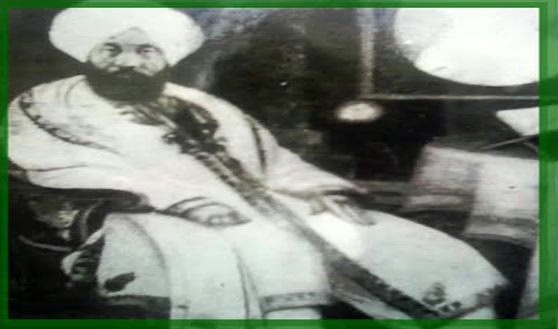


The late Mirwaiz founded Anjuman Nusrat-ul-Islam in 1899 and is remembered as ‘Sir Syed of Kashmir’ for his pioneering role in advocating modern education alongside traditional Islamic teachings
It is a universal and eternal principle of nature that neither individuals nor nations remain in the same state forever. Progress and decline, highs and lows, are the laws of nature from which no escape is possible. The 19th century, in general, was a particularly dark and challenging period for Islam and the Muslim Ummah. Specifically, in the region of Jammu and Kashmir, despair and helplessness were rampant.
The majority of the population was uneducated, impoverished, and trapped in the clutches of exploitation. Basic needs and amenities were out of reach, and the chains of slavery bound them tightly. On one hand, the oppressive rule of Dogra kings had turned Kashmir into a dark dungeon. Forced labour was extracted from the people, and they were subjected to extreme deprivation and ignorance. On the other hand, imperial forces were attacking the Islamic world, subjugating regions like Africa, the Middle East, India, and Southeast Asia.
These colonial powers targeted the Muslim community’s economic, intellectual, and social capabilities. In addition to political slavery, they also altered the educational structure to suit their agendas, reshaping people’s thoughts, consciousness, and character. Simultaneously, they launched cultural invasions through missionary activities, exploiting the poverty of the people to spread their influence.
In this bleak scenario, Allah’s law of nature intervened. A few sincere, far-sighted, and conscious individuals from the Muslim Ummah recognised the dangers and began to devise ways to counter these challenges, despite their limited resources. Among these was the resolute and visionary Mirwaiz of Kashmir, Allama Ghulam Rasool Shah Sahib (RA), who stepped forward with an unshakable determination to confront these adversities.
Mirwaiz Rasool Shah Sahib (RA’s) Vision and Struggles
Mirwaiz Rasool Shah Sahib (RA) was a man of foresight, intellect, and deep understanding. Through his sermons, he not only introduced Islamic teachings to the people but also awakened political and social consciousness. He launched a successful campaign to eradicate superstitions, innovations, and harmful customs. However, he realized that true liberation from intellectual, social, and political slavery could only be achieved through education.
Drawing from the Quranic verse, _”Indeed, Allah will not change the condition of a people until they change what is in themselves” (Surah Ar-Ra’d: 13:11)_, he decided to establish an organised educational movement. In collaboration with other intellectuals, he founded Anjuman Nusrat-ul-Islam in 1899 (1317 AH) in Srinagar and became its first president.
Foundation of Islamia School
Under the auspices of Anjuman Nusrat-ul-Islam, the Islamia School was established in Rajouri Kadal in 1899. Initially a middle school, it gradually became a high school. Later, it expanded to include the Oriental College, which taught Arabic and Islamic studies. This marked the beginning of an educational revolution in Kashmir, replacing the darkness of ignorance with the light of knowledge.
Mirwaiz Rasool Shah Sahib (RA) emphasized balancing modern education with Islamic values, fearing that neglecting the Islamic identity would pave the way for ideological and cultural invasions. His efforts bore fruit, and the educated youth of Kashmir began to emerge as influential figures, taking up significant roles in the administration and development of the region.
Contributions to Education and Social Reform
Mirwaiz Rasool Shah Sahib (RA) is often remembered as the “Sir Syed of Kashmir” for his pioneering role in advocating modern education alongside traditional Islamic teachings. Despite facing opposition, as English education was equated with becoming non-Muslim, he firmly stood his ground and laid the foundation of institutions that nurtured generations of educated and responsible individuals.
The objectives of Anjuman Nusrat-ul-Islam included:
- Promoting the teachings of the Quran and Sunnah.
- Combining Islamic and modern education to equip the new generation.
- Instilling Islamic moral values in Muslims.
- Providing guidance on religious, moral, social, and economic matters.
- Striking a balance between modern education and religion.
- Highlighting spiritual and ethical values.
- Fostering unity among Muslims.
Legacy and Leadership
After the demise of Mirwaiz Rasool Shah Sahib (RA) in 1909, the following notable individuals succeeded him as presidents of Anjuman Nusrat-ul-Islam:
- Mirwaiz Ahmedullah Sahib (RA) (1909–1913)
- Mirwaiz Atiqullah Sahib (RA) (1913–1926)
- Mirwaiz Muhammad Yousuf Shah Sahib (RA) (1926–1947)
- Molvi Muhammad Amin Sahib (RA) (1947–1963)
- Shaheed-e-Millat Mirwaiz Molvi Muhammad Farooq Sahib (RA) (1963–1990)
- Mirwaiz Molvi Umar Farooq Sahib (1990–present)
Impact and Achievements
Anjuman Nusrat-ul-Islam has played a transformative role in Kashmir’s educational and social landscape. Its initiatives have produced generations of educated Muslims who have contributed significantly to the progress and development of the region.
Mirwaiz Rasool Shah Sahib’s (RA) efforts extended beyond education to the renovation and maintenance of important religious sites, including the Jamia Masjid Srinagar and Khanqah Naqshbandiya.
Conclusion
Mirwaiz Rasool Shah Sahib (RA) passed away on 30th July 1909 at the age of 45. His legacy remains a guiding light for the Muslim community, illuminating the path from ignorance to enlightenment. Anjuman Nusrat-ul-Islam continues to work towards the betterment of the Ummah, upholding the vision of its founder.
May Allah grant him the highest ranks in Paradise for his invaluable contributions. Ameen.
The writer is the Editor, Anjuman Nusrat-ul-Islam, Srinagar
Note: This paper was presented at a seminar in Srinagar organised under the patronage of the Fakhruddin Ali Ahmed Memorial Committee, Lucknow (UP), in collaboration with Mahasagar Shiksha Samiti, Prayagraj and Inder Cultural Forum, Sonawari.
M.S. Rehman Shams