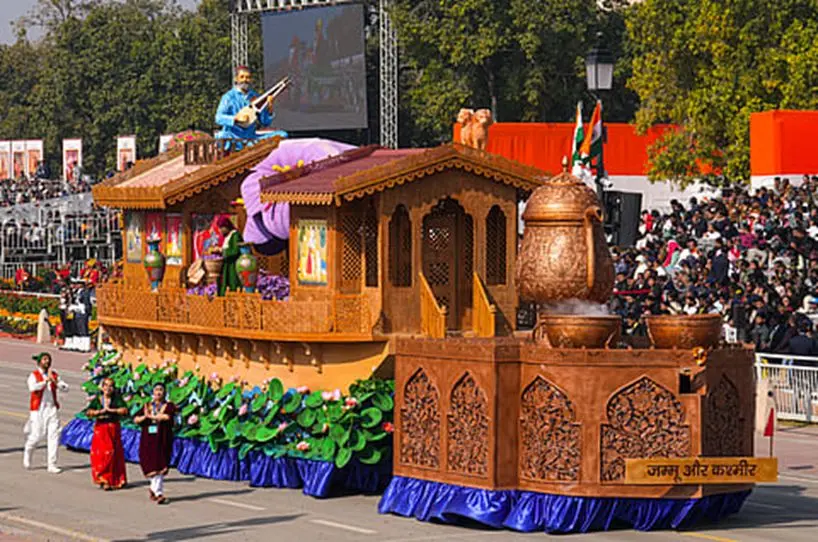


Was Republic Day’s Kashmiri tableau representation or appropriation — culture worn, applauded, but its people absent?
Mahoor Haya Shah
On Kartavya Path on the 77th Republic Day of India, Jammu and Kashmir walked proudly — draped in colour, confidence and choreography. Or so it appeared.
The Pheran flowed. The music echoed. The camera smiled. And Kashmir watched… from a distance.
What unfolded on the grand boulevard of New Delhi was not so much a celebration of Kashmiri culture as it was a carefully staged imitation: a performance where Kashmir existed as an idea, but Kashmiris themselves were conspicuously absent.
Non-locals wrapped themselves in our Pherans, garments that are not mere winter wear but vessels of memory…of snowbound afternoons, kangris warming frozen hands, of generations stitched into wool and thread. The pheran is not a costume. It is lived history. Yet on Kartavya Path, it became a wardrobe which was worn briefly, applauded generously and removed without consequence.
More perplexing were the creative liberties. Colourful turbans and stylised headgear— attire belonging to other Indian states were quietly folded into the Kashmiri tableau. As if our culture required embellishment. As if authenticity was negotiable. As if Kashmir, in its own form, was somehow incomplete.
This is where representation quietly slips into cultural appropriation.
Appropriation is not admiration. It is the act of borrowing without context, without consent and without credit. It is when culture is extracted for display while its people are edited out of the frame. What remains is an aesthetic — polished, palatable and safely disconnected from lived reality.
One is compelled to ask:
When did Kashmir become a costume rather than a community?
Cultural representation is not about choreography alone. It is about authorship; who tells the story, who shapes the narrative, who stands behind the symbols. When Kashmir is showcased without Kashmiris, it becomes folklore without roots– beautiful, perhaps, but unmoored.
It is easier, after all, to dress a culture than to engage with it. Easier to curate than to converse. Easier to celebrate identity than to accommodate voices that carry complexity, memory and inconvenient truths.
The irony is unmistakable. A parade that claims unity in diversity quietly demonstrated how diversity is often managed…flattened into spectacle, stripped of agency and performed at a safe distance.
Kashmir was present on Kartavya Path but only as an aesthetic, carefully sanitised, artistically diluted and politically neutral. A version that could be applauded without being heard.
But culture is not ornamental. It does not exist to decorate national narratives. It lives, breathes, resists and remembers, and that is through people.
Representation without representation is spectacle. Inclusion without voice is an illusion.
Celebration without consent is appropriation.
Kashmir does not need to be worn to be understood. It needs to be invited, involved and listened to.
Until then, the Valley will continue to watch itself being performed— admired, photographed, applauded, yet absent from its own stage.
And perhaps that silence, more than the music, says everything.
Mahoor Haya Shah is a writer from Srinagar
ha*********@***il.com